
Handling “call me later” well means treating it as a request with a time attached, not as a soft no. A customer who says “baad me call karna” has told you two things: they are still willing to talk, and now is wrong. The job is to find out when is right, call at exactly that time, and pick up the conversation where it stopped. This guide covers how to do that by hand, and how MySA Business does it on AI calls.
What “call me later” usually means
The same words cover very different situations. How you respond depends on which one it is:
| What the customer says | What it usually means | What to do |
|---|---|---|
| “Abhi driving kar raha hoon” | Busy right now, interested enough to answer | Ask for a time, keep it under ten seconds |
| “Abhi match chal raha hai, shaam ko karo” | A specific window they already have in mind | Take the time they gave and call then |
| “Ghar pe baat karke batata hoon” | Someone else is part of the decision | Ask when they will have spoken, and call after that |
| “Rate bhej do, phir dekhte hain” | They want information first | Send it, then call at an agreed time |
| “Baad me” with nothing else, twice | A polite no | Ask once if they would rather not be called; respect the answer |
The first four are real leads. The last is not, and calling it a fifth time costs you the customer's goodwill.
Five rules for a call-back that works
- Get a time, not a promise. “Kab call karun, shaam 6 baje theek rahega?” turns “later” into a slot. A vague “later” is how call-backs get lost.
- Repeat it back. “Theek hai, aaj shaam 6 baje.” The customer hears that you will actually call.
- Note what they wanted. The next call should start from “aap Sunday ke liye bangles dekh rahe the”, not from “Hello, main XYZ se bol raha hoon”.
- Call at that time, in the same language. A call at 6:40 when they said 6 feels like any other cold call. So does a switch from Hindi to English.
- Stop when it becomes a no. If the second call also ends in “baad me” with no time, ask directly whether they want to be called again.
Most teams know these rules. They break down because the call-back lives in someone's memory, a notebook or a WhatsApp note to self, and the person who heard it is busy when the time comes.
How MySA Business schedules the call-back
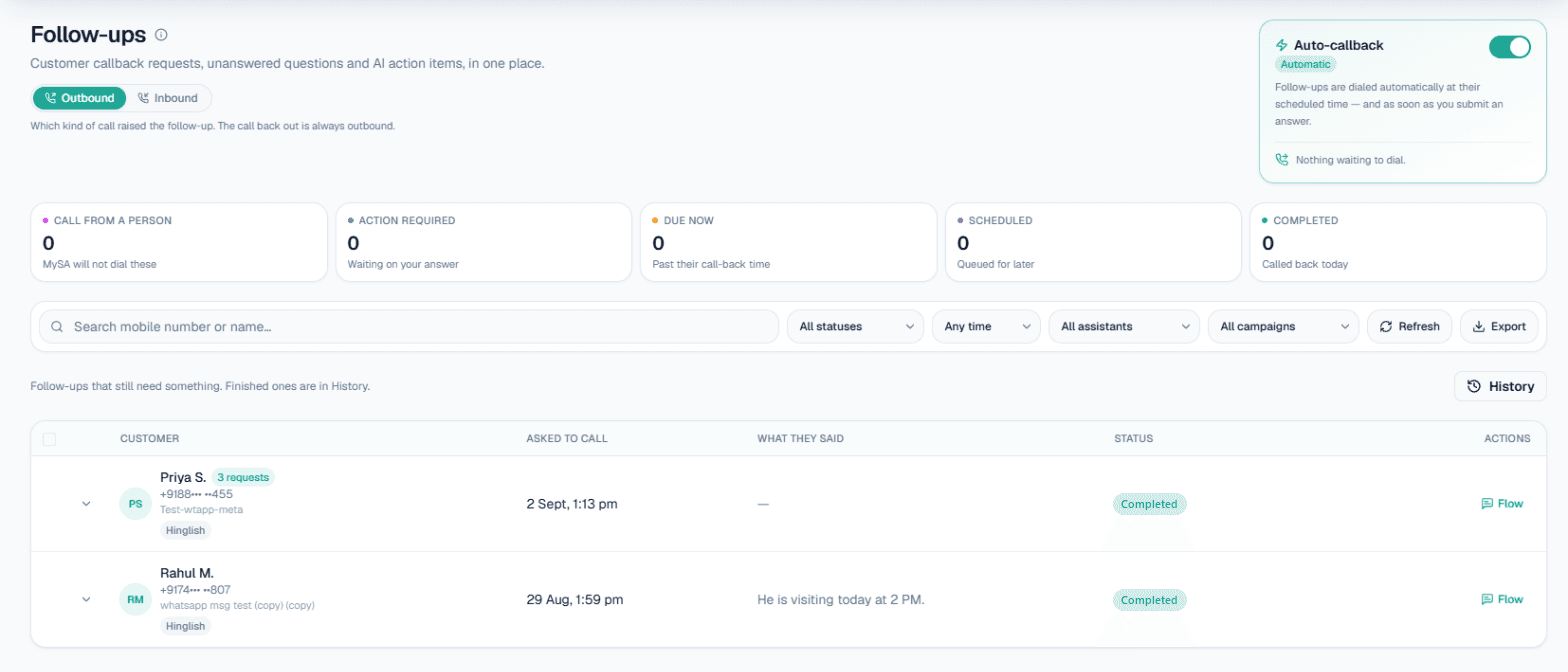
On AI calls, MySA Business does the remembering. When a customer asks to be called back, the AI picks up the time from what they said, such as “10 minute baad”, “kal 3 baje” or “shaam ko”, and adds it to Calling → Follow-ups.
- Same conversation, picked up again. The call-back reuses the original call's assistant, purpose and script, so it continues rather than starts over.
- Same language. It is spoken in the language that customer was last spoken to in, shown on the row before it dials.
- Automatic or by hand. Switch on Auto-callback and follow-ups dial at their scheduled time. With it off, they wait until someone presses Call now.
- Quiet hours respected. Calls that fall inside your DND hours are held, not dropped.
Example
AI: Namaste, main ABC Electronics se bol raha hoon. Aapne AC service ke baare mein poocha tha.
Customer: Haan, par abhi India ka match chal raha hai. Shaam 7 baje ke baad call karo.
AI: Bilkul, main aapko aaj shaam 7 baje call karta hoon. Enjoy the match.
That evening, the row shows Scheduled for 7 PM. With Auto-callback on, the AI rings at 7, in Hinglish, and opens with the AC service the customer asked about. The business is made up; the flow is how the product works.
The two call-backs MySA will not place for you
Not every “call me later” should go back to the AI:
- Call from a person. If the customer asks to speak to someone on your team, the follow-up is marked Call from a person and MySA never dials it. Ringing them back with the assistant they just declined would repeat what they turned down. A colleague calls and presses Mark called back. If you would rather connect them during the call itself, set up Call transfer.
- Action required. If the customer asked something your Business Details do not cover, the AI says it will find out instead of guessing. The follow-up waits for your answer: press Answer, type it, and press Save & schedule call, and the AI gives the customer your answer on the call-back.
“Call me later” versus “I will come on Friday”
A call-back is something the customer asked for. A visit is a plan they mentioned: “main Friday aa jaunga”. MySA keeps them apart. Visit plans go to Calling → Visit reminders, which rings on the day to confirm, and they never appear in the Follow-ups queue. See Visit reminders.
Checking that call-backs actually happen
A call-back that was promised and missed is worse than none. In MySA Business you can check three places:
- Follow-ups, by status: Due now means it is past its time and has not been called yet.
- Call Logs, where each call has its recording, AI summary, sentiment and a follow-up column.
- Lead Feed, where you can switch on Tell me when a customer asks to speak to a person, so those requests reach your team the moment they happen.
More on reading results is in lead tracking for AI calls.
Getting started
- Create a workspace and verify your mobile number to get ₹100 of Test credit in the separate Test environment.
- Press Try now so the AI rings your own phone, and say “baad me call karna, shaam 6 baje”. Then look at Follow-ups.
- Go Live, top up the prepaid wallet, and decide whether to switch on Auto-callback.
Calls of 10 seconds or less are free; longer calls are billed per started minute, and a call-back is billed like any other call. The rate for your workspace is shown in the console. Talk to sales for volume pricing. The feature overview is on AI follow-up calls.